If you want to learn more about C and Fortran order, you canread more about the internal organization of NumPy arrays here. Essentially, C and Fortran orders have to do with how indices correspond to the order the array is stored in memory. In Fortran, when moving through the elements of a two-dimensional array as it is stored in memory, the firstindex is the most rapidly varying index.

As the first index moves to the next row as it changes, the matrix is stored one column at a time. This is why Fortran is thought of as a Column-major language. In C on the other hand, the last index changes the most rapidly. The matrix is stored by rows, making it a Row-major language. What you do for C or Fortran depends on whether it's more important to preserve the indexing convention or not reorder the data. The NumPy library contains multidimensional array and matrix data structures (you'll find more information about this in later sections).

It providesndarray, a homogeneous n-dimensional array object, with methods to efficiently operate on it. NumPy can be used to perform a wide variety of mathematical operations on arrays. So far we have examined only one-dimensional NumPy arrays, that is, arrays that consist of a simple sequence of numbers. However, NumPy arrays can be used to represent multidimensional arrays. For example, you may be familiar with the concept of a matrix, which consists of a series of rows and columns of numbers.

Matrices can be represented using two-dimensional NumPy arrays. Higher dimension arrays can also be created as the application demands. Pandas is a great library for handling big datasets but we will use only a small part of it to read our data file. Numpy is a library that makes life easier when handling arrays, hence we import that too. We will see in the following code how these will be used. Running your code at this point will do nothing that you will see.

You will certainly see errors if the modules were not installed properly. A neural network is a model that uses weights and activation functions, modeling aspects of human neurons, to determine an outcome based on provided inputs. It can be used for many different scenarios and classification is one of them. For this section, you'll use the Keras library with TensorFlow to construct the neural network, and explore how it handles the Titanic dataset. Visual Studio Code and the Python extension provide a great editor for data science scenarios. With native support for Jupyter notebooks combined with Anaconda, it's easy to get started.

We can see that there are 1,000 rows for the 1,000 samples in the dataset. We can also see that the input data has two columns for the two input variables and that the output array is one long array of class labels for each of the rows in the input data. This tutorial demonstrates using Visual Studio Code and the Microsoft Python extension with common data science libraries to explore a basic data science scenario. Since it's a black and white image, R, G, and B are all similar.

An RGBA , has 4 values per inner list, and a simple luminance image just has one value (and is thus only a 2-D array, not a 3-D array). For RGB and RGBA images, Matplotlib supports float32 and uint8 data types. If your array data does not meet one of these descriptions, you need to rescale it.

The data is returned as a "DataFrame" which is a 2 dimensional spreadsheet-like data structure with columns of different types. Pandas has two main data structures - DataFrame and Series. A Series is a one-dimensional array that can hold any value type - This is not necessarily the case but a DataFrame column may be treated as a Series.

Now, you can analyze the correlation between all the input variables to identify the features that would be the best inputs to a machine learning model. The closer a value is to 1, the higher the correlation between the value and the result. Use the following code to correlate the relationship between all variables and survival.

Now that the data is in good shape, you can use seaborn and matplotlib to view how certain columns of the dataset relate to survivability. Add the following code to the next cell in your notebook and run it to see the generated plots. %run can execute python code from .py files – this is well-documented behavior. Lesser known is the fact that it can also execute other jupyter notebooks, which can quite useful.
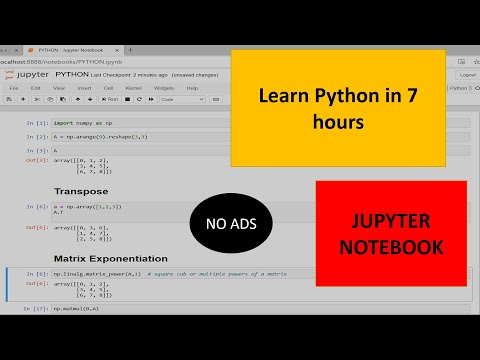
NumPy gives you an enormous range of fast and efficient ways of creating arrays and manipulating numerical data inside them. While a Python list can contain different data types within a single list, all of the elements in a NumPy array should be homogeneous. The mathematical operations that are meant to be performed on arrays would be extremely inefficient if the arrays weren't homogeneous. For example, in the case of a two-dimensional array, whether or not it is truncated is determined by the total number of elements regardless of the number of rows and columns. For example, we could make a prediction for each of the 1,000 examples in the training dataset as we did in the previous section when evaluating the model.

In this case, the model would make 1,000 distinct predictions and return an array of 1,000 integer values. One prediction for each of the 1,000 input rows of data. Congratulations you have learned how to make a dataset of your own and create a CNN model or perform Transfer learning to solving a problem. We learned a great deal in this article, from learning to find image data to create a simple CNN model that was able to achieve reasonable performance. We also learned the application of transfer learning to further improve our performance. Transfer learning is a machine learning technique where a model trained on one task is re-purposed on a second related task.
Another crucial application of transfer learning is when the dataset is small, by using a pre-trained model on similar images we can easily achieve high performance. Since our problem statement is a good fit for transfer learning lets see how we can go about implementing a pre-trained model and what accuracy we are able to achieve. There are many different machine learning algorithms that you could choose from to model the data. The scikit-learn library also provides support for many of them and a chart to help select the one that's right for your scenario. For now, use the Naïve Bayes algorithm, a common algorithm for classification problems. Add a cell with the following code to create and train the algorithm.

Next, you'll normalize the inputs such that all features are treated equally. For example, within the dataset the values for age range from ~0-100, while gender is only a 1 or 0. By normalizing all the variables, you can ensure that the ranges of values are all the same. Use the following code in a new code cell to scale the input values.

This problem can be corrected by replacing the question mark with a missing value that pandas is able to understand. Add the following code to the next cell in your notebook to replace the question marks in the age and fare columns with the numpy NaN value. Notice that we also need to update the column's data type after replacing the values. Numpy is the fundamental library of python, used to perform scientific computing. It provides high-performance multidimensional arrays and tools to deal with them. A NumPy array is a grid of values that are indexed by a tuple of positive integers.

Numpy arrays are fast, easy to understand and give users the right to perform calculations across entire arrays. NumPy arrays are faster and more compact than Python lists. NumPy uses much less memory to store data and it provides a mechanism of specifying the data types. These kinds of operations with arrays are called vectorized operations because the entire array, or "vector", is processed as a unit. Vectorized operations are much faster than processing each element of arrays one by one. You will see examples of this later on when we discuss loops in Chapter 6.

In NumPy documentation, is similar to a list but where all the elements of the list are of the same type. The elements of a NumPy array, or simply an array, are usually numbers, but can also be boolians, strings, or other objects. When the elements are numbers, they must all be of the same type. For example, they might be all integers or all floating point numbers. Dictionaries are like lists, but the elements of dictionaries are accessed in a different way than for lists.

The elements of dictionaries are accessed by "keys", which can be either strings or integers . However, we do not make much use of them in this introduction to scientific Python, so our discussion of them is limited. Because of the different data types and ranges you can't simply stack the features into NumPy array and pass it to a keras.Sequential model. I have trained a machine learning model on multiple embeddings at a time and i want to test on just one embedding.

The input shape of my model is (?, 10, 300) 10 embeddings with a dimension of 300. In this tutorial, you discovered how to relate the predicted values with the inputs to a machine learning model. In this tutorial, you will discover how to relate the predicted values with the inputs to a machine learning model.

Let's define a function called get_data() that makes it easier for us to create our train and validation dataset. We define the two labels 'Rugby' and 'Soccer' that we will use. We use the Opencv imread function to read the images in the RGB format and resize the images to our desired width and height in this case both being 224. Here we will be making use of the Keras library for creating our model and training it. We also use Matplotlib and Seaborn for visualizing our dataset to gain a better understanding of the images we are going to be handling. Another important library to handle image data is Opencv.

In this tutorial of Python Examples, we created one-dimensional numpy array using different built-in functions. One dimensional array contains elements only in one dimension. In other words, the shape of the numpy array should contain only one value in the tuple. Often times we need to apply a function to a column in a dataset to transform it. In this example, we will map the values in the "geography_type" column to either a "1" or "0" depending on the value.

We will append this information to the DataFrame in a new column. Let's check whether our data set has been imported as we would expect. A simple check is to see if the data types have been correctly interpreted. These graphs are helpful in seeing some of the relationships between survival and the input variables of the data, but it's also possible to use pandas to calculate correlations. To do so, all the variables used need to be numeric for the correlation calculation and currently gender is stored as a string. To convert those string values to integers, add and run the following code.

You can think of them as fast vectorized wrappers for simple functions that take one or more scalar values and produce one or more scalar results. Pandas also provides some more domain-specific functionality like time series manipulation, which is not present in NumPy. Arrays are a collection of data elements of the same type under the same name. In Python, we can implement arrays using lists or the NumPy module. The NumPy module provides us with arrays of type ndarray. The use of random number generation is an important part of the configuration and evaluation of many numerical and machine learning algorithms.

All you need to do to create a simple array is pass a list to it. If you choose to, you can also specify the type of data in your list.You can find more information about data types here. Let's preprocess our data a little bit before moving forward. Weekly data can be tricky to work with since it's a briefer amount of time, so let's use monthly averages instead.

For simplicity, we can also use the fillna() function to ensure that we have no missing values in our time series. This tutorial will require the warnings, itertools, pandas, numpy, matplotlib and statsmodels libraries. The warnings and itertools libraries come included with the standard Python library set so you shouldn't need to install them. Unlike make_csv_dataset this function does not try to guess column data-types. You specify the column types by providing a list of record_defaults containing a value of the correct type, for each column. To build the preprocessing model, start by building a set of symbolic keras.Input objects, matching the names and data-types of the CSV columns.

Running the example, the model makes 1,000 predictions for the 1,000 rows in the training dataset, then connects the inputs to the predicted values for the first 10 examples. Running the example creates the dataset and prints the shape of each of the arrays. The example below creates the dataset with separate arrays for the input and outputs . This problem might seem simple or easy but it is a very hard problem for the computer to solve.

As you might know, the computer sees a grid of numbers and not the image of a cat as how we see it. Images are 3-dimensional arrays of integers from 0 to 255, of size Width x Height x 3. The 3 represents the three color channels Red, Green, Blue.

When a notebook is saved as a .py file, all text in markdown cells is converted to comments, and any code cells stay intact as Python code. After a code cell is run, an output cell can be produced below the code cell. The output cell contains the output from the code cell above it. Not all code produces output, so not all code cells produce output cells. If a code cell produces plots, charts or images, these outputs are shown in output cells. In this example, we will import numpy library and use linspace() function to crate a one dimensional numpy array.
Numpy linspace() functions takes start, end and the number of elements to be created as arguments and creates a one-dimensional array. Run In this example, we will import numpy library and use arange() function to crate a one dimensional numpy array. In this example, we will import numpy library and use array() function to crate a one dimensional numpy array. Numpy array() functions takes a list of elements as argument and returns a one-dimensional array. With thenumber of public notebooks on GitHubexceeding 1.8 million by early 2018, it is surely the most popular independent platform for sharing Jupyter projects with the world.

GitHub has integrated support for rendering.ipynbfiles directly both in repositories and gists on its website. If you aren't already aware,GitHubis a code hosting platform for version control and collaboration for repositories created withGit. You'll need an account to use their services, but standard accounts are free. You'll notice that in fact when looked at from the standpoint of whether a person had relatives, versus how many relatives, there is a higher correlation with survival. To do so, copy the code below into the first cell of the notebook.


